
You did the research. You tested the mattresses. You made the call — and now your brand-new mattress is set up, the sheets are on, and you're ready for the best sleep of your life. And then… it just feels kind of weird.
Not bad, necessarily. Just different. Maybe a little firm. Maybe a little stiff. Maybe enough to send you spiraling into a 1 a.m. Google search that starts with "is my new mattress supposed to feel like this."
Spoiler alert: yes. Probably.
Breaking in a new mattress is a real thing, and most people don't know it's happening until they're already second-guessing themselves. So before you panic, our experts at Carmona’s Appliance Center are here to walk you through what's actually going on — and why a little patience goes a long way.

Your Mattress Needs Time to Catch Up
Your mattress isn't fully itself yet. The materials inside — whether foam, coils, or a combination of both — are still adjusting to your weight, your warmth, and the way you sleep. That process takes time, and it looks a little different depending on what's inside your mattress.
- Foam mattresses: Memory foam and other foam layers soften gradually as they respond to body heat and pressure. Fresh out of the box, they can feel noticeably firmer than they will a few weeks in.
- Hybrid mattresses: The coil system needs time to flex and find its rhythm, while the comfort layers on top go through their own softening process — so you're essentially waiting on two things at once.
- Bed-in-a-box models: These need extra grace. Compressed and rolled for shipping, they can take 24–72 hours just to fully expand — and even longer to feel their best.
The general break-in window is somewhere between 30 and 90 days, depending on the materials and how much time you're actually spending on it. That's not a design flaw. That's just how it works.
Pro Tip:
Sleep on your new mattress as much as possible during those first few weeks — even naps count. The more time you spend on it, the faster it adjusts.
Your Body Needs Time Too
Your mattress isn't the only one going through an adjustment period — you are too. Your body has spent months (or years) conforming to your old mattress, whatever shape it was in. And if that mattress had some sag, some soft spots, or some very specific dips worn in exactly where you sleep, your muscles and pressure points have fully adapted to all of it.
A new mattress changes that equation. Even if the support is objectively better, your body needs time to catch up.
- Muscles and pressure points: Your body may feel a little achy or unsettled in the first week or two as it adjusts to a new support level. This is normal — think of it like switching from worn-out shoes to a properly supportive pair. The right fit can still take some getting used to.
- Sleep positions: If your old mattress had deep impressions, you may have been sleeping in a slightly different position than you realized. A new, even surface can shift things back — and your body will notice.
- The mental adjustment: Sometimes the discomfort is more about expectation than anything physical. When we anticipate instant comfort and don't get it, "different" can feel like "wrong" — even when everything is actually fine.

Normal Adjustment vs. "Something's Actually Wrong"
Not every uncomfortable feeling means your mattress is a bad fit — but it's fair to want to know the difference. Most of what you'll feel in the first few weeks falls squarely into the "totally normal" category. Every once in a while, though, there are signs worth paying closer attention to.
Here's how to tell them apart:
- Normal = overall firmness or stiffness: If the mattress feels a bit rigid at first, that's the materials doing their thing. This typically softens with time and use, especially in foam and hybrid constructions.
- Normal = minor pressure or achiness: A little adjustment discomfort in your shoulders, hips, or back is common when your body is adapting to new support levels. It usually eases up within the first few weeks.
- Worth noting = persistent pain or discomfort: If you're waking up with significant pain — not just "hm, that's different" but genuinely uncomfortable — and it isn't improving after several weeks, that's worth a conversation with an expert.
- Worth noting = visible or structural issues: Sagging, uneven surfaces, or anything that looks off right out of the gate isn't a break-in issue. That's a different problem entirely.
Pro Tip:
Keep a quick mental note — or even a short log — of how you feel each morning during the first month. Patterns are easier to spot when you're actually tracking them.
Tips to Speed Up the Break-In
Patience is great in theory — but if you're lying awake at 2 a.m. wondering when this mattress is going to start feeling amazing, a little action doesn't hurt. There are a few simple things you can do to help the process along and get to the good part faster.
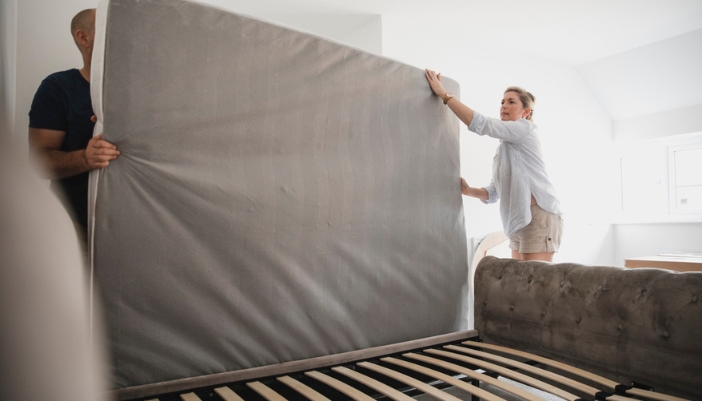
- Rotate your mattress: Giving your mattress a 180-degree rotation every couple of weeks during break-in helps distribute wear more evenly and encourages the materials to adjust across the whole surface — not just your favorite sleep spot.
- Check your foundation: A worn-out box spring, an unsupportive bed frame, or the wrong base can make even a great mattress feel off. If something still seems wrong after a few weeks, it's worth ruling out what's underneath before assuming the mattress is the problem.
- Keep your bedroom comfortable: Temperature plays a bigger role than most people expect. A cooler room helps foam materials respond more consistently — and honestly, it just makes for better sleep while you're waiting things out.
Pro Tip:
If your mattress arrived compressed and rolled, give it at least 24–72 hours to fully expand before making any judgments. First impressions on a bed-in-a-box aren't always the full picture.
Good Things Come to Those Who Wait (and Rotate)
Better sleep doesn't always happen on night one — and that's okay. Breaking in a new mattress is a process, but it's one with a really good night's sleep at the end of it. Give your mattress time to adjust, give your body the same courtesy, and don't panic at the first sign of "different."
Most of the time, a little patience is all it takes to get from "hm, this is strange" to "I can't believe I ever slept on anything else."
And if you're a few weeks in and still have questions, our experts at Carmona’s Appliance Center are here to help. Stop in to ask anything on your mind, explore our mattress selection, and find the comfort that fits the way you actually sleep — because the right match makes all the difference.